As I say in one of my previous posts, you can get some pretty decent recordings with a very basic recording setup. But I’d like to be clear about something first: I’m NOT going to tell you EXACTLY what to use or buy! You’ll always have to make those decisions for yourself. Why? Because you’re the only person who knows what exactly do you need. What I’ll try to do is give you some useful tips to help you make those decisions…
Let us start
If we look at the basic recording chain we always have to have some kind of sound source, then the element that picks up this sound and transport it to the audio interface, where it is converted to a digital signal that your computer can understand and record in your DAW. When you play back your recording, your audio interface convert it again from digital into analog and send it to your headphones and/or speakers that are connected to the output of your interface. In a nutshell, that’s about it!
The most important thing
One thing that plays the most important role in the recording process is also the thing we always forget about: the room! The truth is: until you do at least some basic acoustic treatment in your room you most certainly won’t get any decent recordings. But here’s some good news: you don’t have to spend hundreds (or even thousands!) of dollars on a professional acoustic treatment! You can do it yourself (there are tons of videos online) or you can use stuff that you already have. For instance, a couch in a corner is a great bass trap, a book shelf is a perfect acoustic panel/diffusor, some heavy curtains can help you tame wall reflections, etc. Just use your imagination but don’t overdo it, you don’t want a dead space…
Closer look at the recording chain
There are sound sources that we record with a microphone (voice, acoustic instruments, horns, guitar and bass amps, etc.) and the ones that we record via cables (synthesizers, direct guitar and bass, other instruments with built-in pickups, etc.). We usually use an XLR-cable to connect the microphone to the interface’s microphone-preamp and we use a 1/4 “ (6.35 mm) phone connector or “jack plug” cable to connect synths & co. with line-input of your interface. Always connect your microphones to the mic-preamp, synths and active pickups with the line-in! Some interfaces also have a so-called Hi-Z input if you want to record an electric guitar with passive pickups direct-in without an amp.
What kind of XYZ should I get?
Microphones: don’t go crazy with microphones right away even if you can afford them! Buy yourself a Shure SM-57 dynamic microphone – every musician on Earth has one of those – and first learn how to get the best sound out of that on every possible source. You can use it on practically anything! Later on you can add a large diaphragm mic to your arsenal for even better recordings on vocals, acoustic instruments, etc.
Cables: Don’t buy cheapo cables! Period. Trust me, they’re nothing but trouble. Buy yourself some mid-price good quality cables and you’ll be very happy with them. You also don’t have to buy high quality studio-top-notch-bla-bla cables because you probably won’t notice the difference anyway but you’ll pay a looot of money for them…
Audio Interface: buy the one that uses the fastest connection on your computer! If you only have USB connection, well, then that’s easy. But if you also have USB-C or even Thunderbolt then you should use one of those because they’re much faster and can process a lot more data. Maybe the interface will be a bit more expensive because of that but trust me, it’s worth it!
You also have to ask yourself how many sources at once you’ll be recording?! If you’re just a guitar/bass player with occasional vocal, then you maybe just need two inputs. But if you’re a drummer and you want to record your acoustic drums, then you’ll need at least four or even more inputs! Maybe you have a friend who’s a bass player and you want to record drums and bass at the same time? And then that bass player knows a guitar player…!? Well, that changes the situation once again…
You don’t have to think that far ahead that maybe someday you’re gonna have a big band so your first audio interface must have 32 inputs! Just in case… Hahaha! Nothing like that! But the difference between 2 and 4 inputs can sometimes be huge so buy wisely…
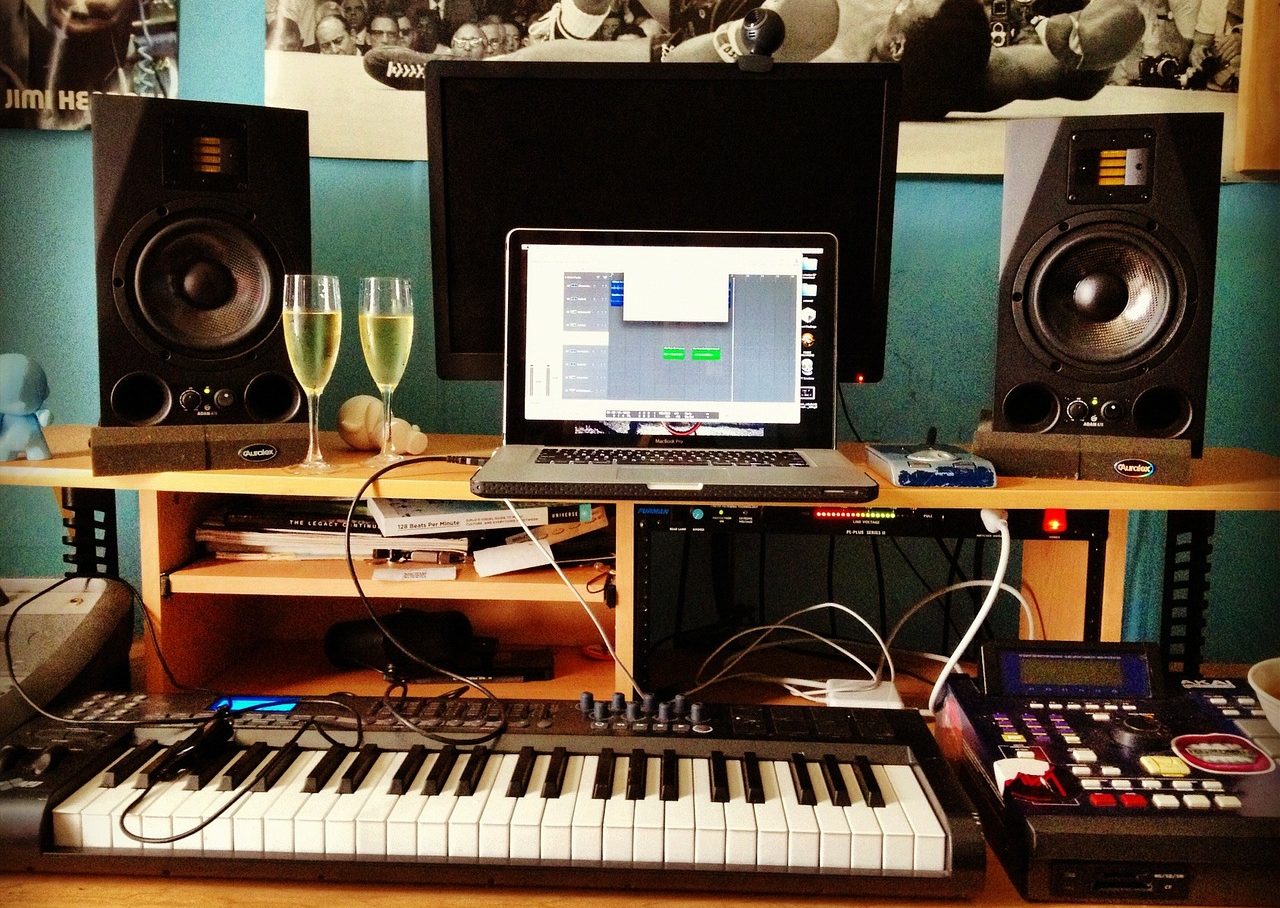
Speakers/Headphones: until your room is somehow treated I would use a pair of studio headphones. You can get really good quality cans for less than 100 $. But if you’ve already done some acoustic treatment in your room then you can also buy yourself a pair of studio speakers. I would go with the active ones because the speaker and the amp are already adjusted to each other so you don’t have to deal with it yourself.
Usually the biggest problem in home studios is the bass. So, if you have a boomy room don’t buy too big and/or too loud speakers because they’ll just make your problems bigger! My momentary room has some bass issues so I bought myself 5″ speakers and they’re great, I can work pretty normally. I listen at rather low volumes when I mix so the bass doesn’t get exaggerated. Of course I‘d rather have 8″s and a bit more “oomph” but my mixes would probably sound awful!
Summary
I think this is more than enough information for you to get you on the hunt for the perfect basic recording setup. As I said I wouldn‘t dare to tell you what to buy but I‘ll say this: you can get (everything good quality beginner stuff!) an audio interface for under 200 $, headphones for under 100 $, speakers for under 200 $, Shure SM-57 for under 100 $ (50 $ used). I even think if you buy everything in one place (Thomann, Sweetwater) you can get everything incl. cables for about 500 $ which is crazy…
Go get ‘em, champ!